






Road Tolls Italy | Driver’s Guide 2026
Heading to Rimini? Or planning a weekend at Lake Garda? Whatever the purpose of your trip, remember that most Italian motorways are tolled. How do you pay motorway tolls in Italy? What is Free Flow? And what should you do if you do not pay at the toll booth? In this guide you will find the key toll information for Italy in 2026.
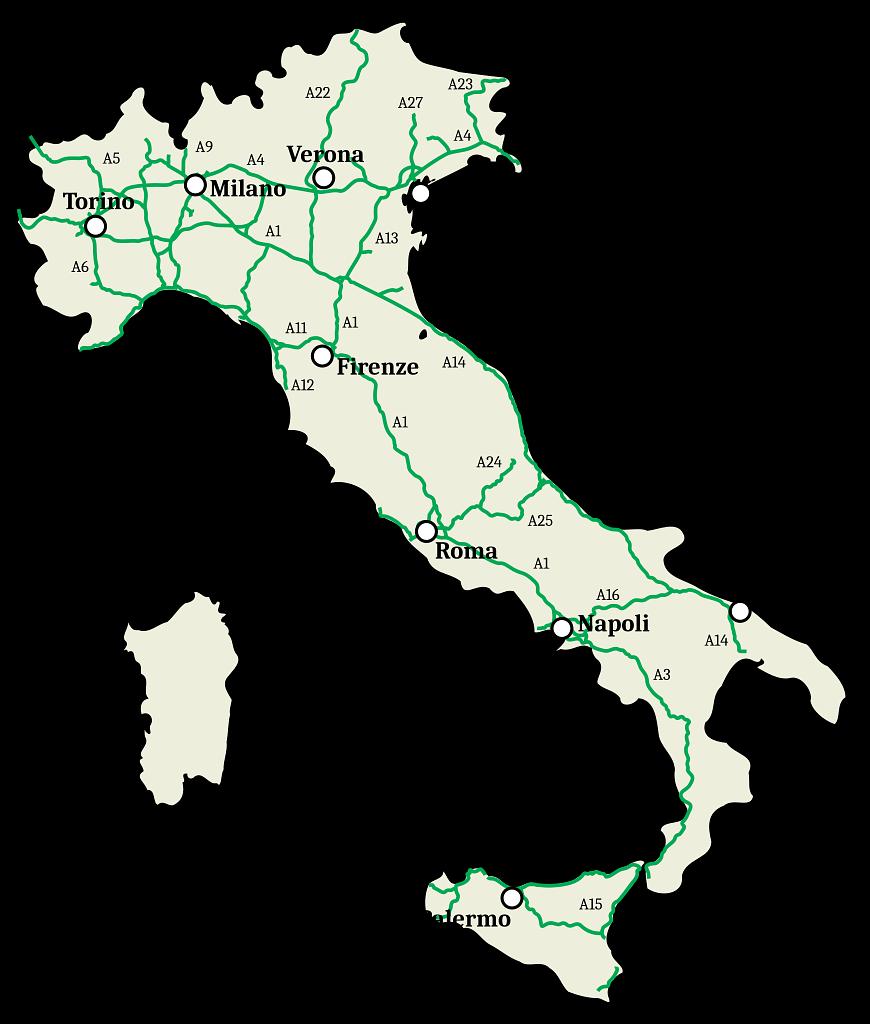
Italy Road Tolls | Map
In Italy, motorway tolls are generally collected at toll booths.
Typically it works like this: you enter the motorway, take a ticket and pay at the exit. The road toll system is run by several operators, the largest of which is Autostrade per l’Italia.
Road tolls in Italy apply to almost all motorway sections and to some tunnels.
Which motorways are tolled in Italy? Below is the map of the main tolled motorway sections in Italy:
Good to know
The A8 Milano–Varese is considered the world’s first motorway. In 2024 it marked 100 years since opening.
Which motorways are toll-free in Italy?
Some motorways and expressways are toll-free. Toll-free sections include, among others:
- A2 Salerno – Reggio Calabria (Autostrada del Mediterraneo),
- A19 Palermo – Catania,
- A29 Palermo – Mazara del Vallo,
- A56 Tangenziale di Napoli,
- A90 Grande Raccordo Anulare in Rome.
You can also travel toll-free on many state, provincial and regional roads. This can help you avoid toll booths, although it often means a longer and slower journey.
Additional road tolls | Tunnels and the Brenner Pass
Some sections, especially Alpine tunnels, are subject to an additional charge.
This is the second type of toll – alongside standard motorway tolls – that you may encounter in Italy. Charges vary depending on the specific section and the vehicle class.
Additional tolled sections connected with travel to or through Italy include:
- Mont Blanc Tunnel (France – Italy),
- Fréjus Road Tunnel (France – Italy),
- Great St Bernard Tunnel (Switzerland – Italy),
- Munt la Schera Tunnel (Switzerland – Italy),
- Brenner Pass (Austria – Italy border).
Good to know
The Brenner Pass toll applies on the Austrian A13 motorway and is separate from the Austrian vignette. You can find more details in the article on road tolls in Austria.
How much does it cost to use the Mont Blanc Tunnel?
The official operator publishes current tolls and subscriptions on the Mont Blanc Tunnel website.
Prices depend on the vehicle class and on whether you buy a single crossing, a return ticket or a multi-trip package. Return tickets for classes 1, 2 and 5 are generally valid for 7 days.
How much does it cost to use the Fréjus Tunnel?
Updated official tariffs are published by the tunnel operator on the SITAF tariffs page.
According to the official tariffs valid from 1 January 2026 on the Italian side, light vehicles pay:
| Vehicle class | Single crossing | Return ticket |
|---|---|---|
| Class 1 (cars) | €56.40 | €70.40 |
| Class 2 (cars with trailer, small campers) | €74.70 | €93.80 |
| Class 5 (motorcycles) | €37.30 | €46.90 |
The same official page also lists tariffs for heavier vehicles, multi-trip passes and monthly flat-rate products.
How does Free Flow work in Italy?
In the Lombardy region, some sections use a barrier-free tolling system called Free Flow.
There are no traditional toll booths or paper tickets there. Instead, cameras read your number plate and the toll is calculated automatically.
According to the official Autostrada Pedemontana Lombarda payment information, journeys must generally be paid within 15 consecutive calendar days.
Italy Road Tolls | Vehicles < 3.5 tonnes
On most Italian motorways, a closed toll system applies.
At the motorway entrance you take a ticket. At the exit you pay for the section travelled – the amount depends on the kilometres driven and the vehicle category.
At the toll booth you will see lanes marked with different colours and symbols:
- Yellow lane – reserved for automatic toll-payment users.
- Blue lane – for card payments and certain prepaid products.
- White lane – for cash or card payments handled by an operator or an automatic machine.
Good to know
If you accidentally enter the wrong lane, do not reverse or make a U-turn. Such manoeuvres are dangerous and punishable.
Vehicle categories up to 3.5 tonnes
| Vehicle category | Vehicle types |
|---|---|
| Class A (2 axles, lower front-axle height) | Cars, many compact SUVs, motorcycles |
| Class B (2 axles, higher front-axle height) | Many larger SUVs, vans, small campers, light commercial vehicles |
The official toll operator explains that Italian tolls depend mainly on the number of kilometres travelled, the vehicle class and whether the route runs through flatland or mountain sections.
You can estimate your route cost using the official Autostrade route and toll tool.
What if I did not take a ticket or could not pay at the toll booth?
If for some reason you do not pay the toll at the exit, an unpaid toll report is issued.
The official Autostrade unpaid toll page explains that unpaid tolls can be settled without extra administrative charges within 15 days.
If you do not have an entry ticket, the operator also provides a self-certification procedure through the same official support flow.
What does the letter “T” mean at an Italian motorway toll booth?
The letter T marks lanes reserved for automatic toll-payment systems. If you do not use such a system, do not enter that lane.
How to pay motorway tolls in Italy
At the entrance to a tolled motorway section, you take a ticket and then settle the toll at the exit. Available payment methods usually include:
- cash,
- debit or credit card,
- fuel card,
- certain prepaid toll products,
- automatic on-board payment systems.
Important
Before relying on any specific prepaid or automatic product, check whether it is accepted on your planned route. Different Italian operators may support different payment options.
Plan your journey across Europe
Before you set off, check the toll requirements in all countries along your route. Purchase the required products in advance to avoid fines and enjoy a smoother trip.
Buy European vignettesTolls in Italy | Vehicles ≥ 3.5 tonnes
HGVs, buses, motorhomes and combinations with trailers with a total mass above 3.5 tonnes also pay to use Italian motorways.
The toll system is based on higher vehicle classes and therefore higher tariffs.
| Vehicle category | Vehicle types |
|---|---|
| Class 3 | Vehicles or combinations with 3 axles |
| Class 4 | Vehicles or combinations with 4 axles |
| Class 5 | Vehicles or combinations with 5 or more axles |
If you often drive on Italian motorways, you can use an on-board device for automatic toll collection. This simplifies toll management and usually allows a smoother passage through automatic lanes.
Good to know
Italian cities also use local ZTL zones (Zona a Traffico Limitato). These are separate from motorway tolls. Paying motorway tolls does not automatically give you permission to enter restricted city centres.
How much is 1 km of motorway in Italy?
There is no single nationwide flat rate for all vehicles and all roads.
According to the official calculation method published by Autostrade per l’Italia, the toll depends on:
- the vehicle class,
- the number of kilometres travelled,
- whether the route is in flatland or mountain terrain,
- the motorway concessionaire.
The same official page also publishes per-kilometre unit rates for classes A, B, 3, 4 and 5 valid from 1 January 2026.
Road Tolls in Italy | Discounts and exemptions
Some operators offer discounts if you frequently travel on the same routes or use an approved automatic toll-payment solution.
Examples of local discounts include selected schemes on routes such as the Pedemontana Lombarda network or on parts of the Milan ring-road system.
Because these promotions can change and may be route-specific, always check the latest conditions directly on the relevant operator’s website before you travel.
Road toll checks in Italy
Italian toll systems record journeys automatically at toll booths or via camera-based systems on certain Free Flow routes.
According to the official operator information, if you do not pay correctly, the vehicle registration number can be recorded and the case may proceed as an unpaid toll matter.
The official toll and reminder pages also state that, depending on the case, non-payment may lead to additional administrative charges and legal enforcement steps.
Road Tolls in Italy | Summary
Tolls in Italy apply on most motorways and on some tunnels. For most routes, you enter the motorway, take a ticket and pay at the exit based on distance travelled and vehicle class. Some networks, such as parts of Pedemontana Lombarda, use a Free Flow system with camera-based recording and a post-journey payment deadline. If you plan to cross Mont Blanc or Fréjus, remember that these tunnels have their own separate tariffs published by their official operators.
Have a safe trip!


