














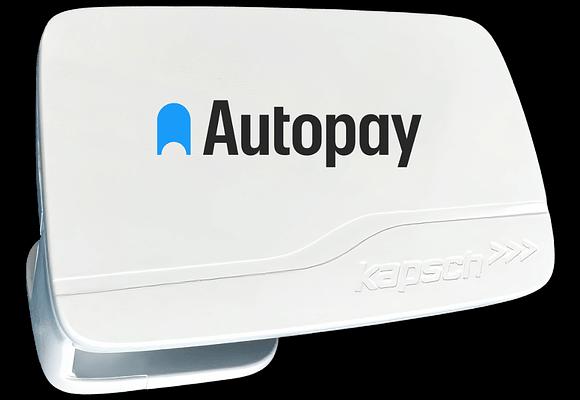

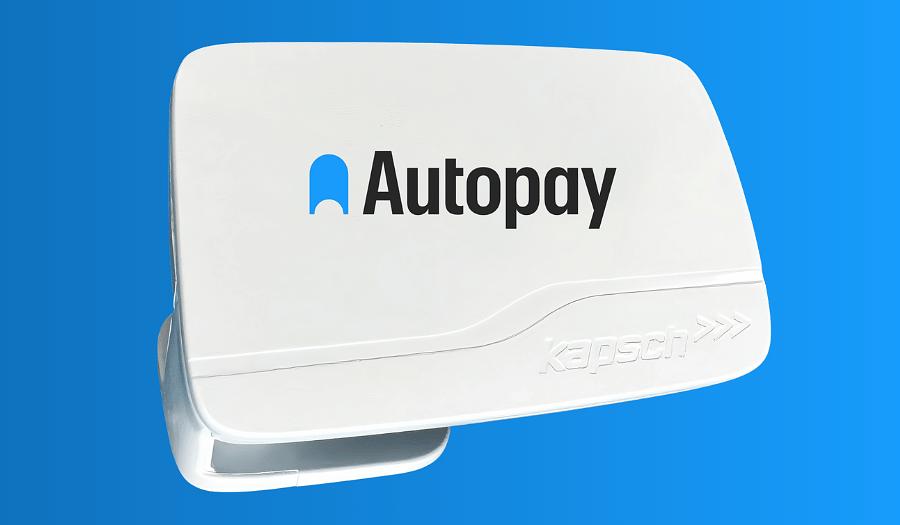
Toll Box - key information

Where does it work?
At motorway toll gates in Italy, France, Spain and Portugal. It also covers selected car parks (ES/FR/PT).
Which vehicles is it for?
For cars and motorhomes up to 3 m high and up to 3.5 t.

Does it require activation?
No. The toll box arrives active and ready to use. Just mount it on the windscreen.

How does payment work?
Toll gates detect the device and journeys are billed together on one invoice. Charges are collected from your linked payment method.
How does the toll box work?
Step 1 Order the device to your home
Register an account, order the device to your home (DHL delivery) and link an automatic payment method.
Step 2 Mount it on the windscreen
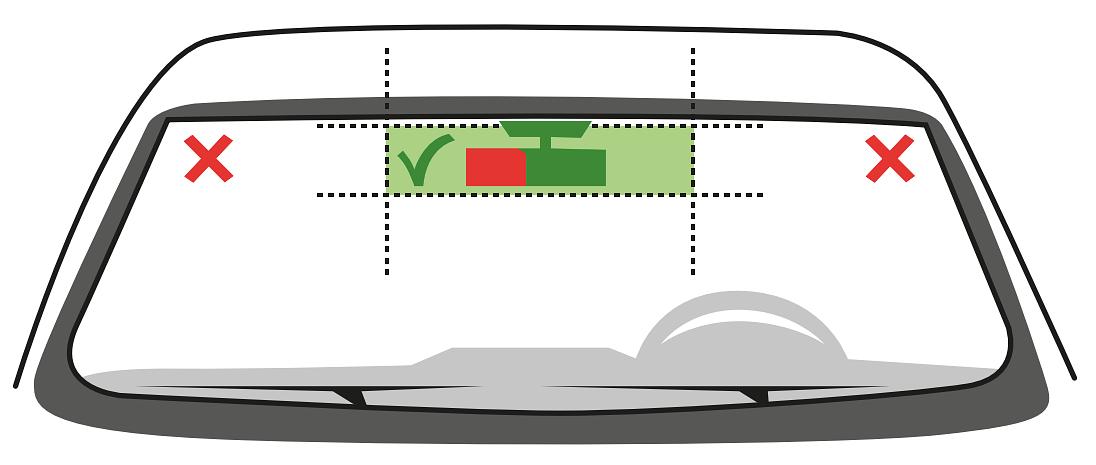
Attach the holder to the device and stick the set in the recommended spot on the windscreen (details below).
Step 3 Drive through the toll gate
The gate antenna communicates with the device - the barrier lifts automatically and the journey is recorded.
Step 4 Billing
The road operator sends transactions to our system, we collect the payment from your linked payment method, and at the end of the month we prepare a consolidated invoice for all journeys.
Mounting the toll box on the windscreen
Instructions 4 simple steps
- Attach the holder to the toll box.
- Clean the spot on the windscreen where you will mount the device*
- Peel the film off the adhesive strip.
- Press the holder with the device onto the windscreen.
Note - coated windscreens
On coated windscreens, mount the device in the uncoated area (usually marked with dots - see your vehicle manual). In alcove motorhomes with no coating/no heated windscreen we recommend mounting it centrally, ~15 cm above the dashboard.
Motorcycle How to carry the device?
The toll box can be used on a motorcycle. We recommend keeping it in a tank bag, protected from rain and cold, facing forward (direction of travel).
How does maut1 work in each country?
Below you'll find practical information on using the toll box in each supported country — which lanes to use, what to avoid and what to know before you set off.
 ItalyMotorways and Telepass
Italy's motorway network (approx. 6,700 km) is one of the densest in Europe. The toll box works with the Telepass system — use lanes marked with a yellow letter "T" or the word "Telepass". You can pass through these lanes at up to 30 km/h, or up to 100 km/h on dedicated "Telepass Free" lanes.
Note: Sicily (motorways A18, A19, A20) is not covered by the Telepass system — pay by card or cash.
Main toll sections: A1 (Milan-Rome-Naples), A4 (Turin-Venice-Trieste), A22 (Brenner), A26 (Genoa).
 FranceLiber-t and Flux Libre
France uses a closed system — the fee depends on the section travelled. Use lanes marked with the letter "t" (Télépéage / Liber-t). You can pass through them at up to 30 km/h without stopping.
On Flux Libre sections (incl. A79, A13/A14) there are no physical toll gates — the device records your journey automatically. Without a toll box you must pay online within 72h, which is the main trap for drivers without a device.
Important for motorhomes:
France classifies vehicles by actual height and weight at the time of passage — not by the registered maximum mass. Thresholds: 3.0 m and 3.5 t. Exceeding either means a higher tariff.
 SpainVIA-T and Telepeaje
Spain's motorway network is private — each operator charges its own tolls. Use lanes marked "Telepeaje", "VIA-T" or "T".
Note: The AP-1 route (Vitoria-Burgos) is excluded from EETS — the toll box won't work on this section; use a card or cash.
Many Spanish motorway sections have been made toll-free in recent years (the former AP-7, AP-9 in Galicia, A-4). Always check the current status before departure at dgt.es.
 PortugalVia Verde and SCUT
Portugal has one of the densest motorway networks in Europe relative to its size. The device works on all lanes in the Via Verde system. On some routes (former SCUT roads) tolls are collected electronically only — without a toll box you must pay online or manually at a gate.
Especially important in Lisbon and Porto: the Vasco da Gama and 25 de Abril bridges and the city tunnels operate in electronic-only mode — without a device you must pay via portaldascomunidades.gov.pt.
 CroatiaHAC and the ENC network
In Croatia the toll box works on motorways run by the HAC operator (incl. the A1 Zagreb-Split-Dubrovnik) in lanes marked "ENC". Istria (the Rijeka-Zagreb motorway) is covered by the PREMIUM device variant.
Croatian tolls are collected in an open system (on entry) or a closed system (at the exit gate). Rates depend on vehicle category and route length.
maut1 vs other OBU devices
Several electronic toll collection devices are available on the market. They differ in coverage, billing model and target group. The comparison below will help you choose the best solution.
| Feature | maut1 / Autopay | Telepass | DKV Box | Axxès |
|---|---|---|---|---|
| Countries | IT, FR, ES, PT, HR | 30+ countries: IT, FR, ES, PT, BE, AT, DE, GR, PL, HR and more | 25+ countries, strong in the truck segment | FR, ES, PT, BE |
| Fee model | Annual fee €22.90 | Monthly subscription ~€3.90-5.90/month | Monthly fee + transaction commission | Monthly subscription ~€4-5/month |
| Cost over 3 years | ~€68.70 | ~€140-212 | Variable — depends on transactions | ~€144-180 |
| Activation | Ready to use — no configuration after mounting | Online registration and activation | Via an advisor (B2B offer) | Online, activation within 24h |
| Invoicing | One consolidated monthly invoice — all countries together | Separate or combined, depending on the plan | Consolidated, dedicated to fleets | Consolidated monthly invoice |
| Vehicles | Cars and motorhomes up to 3 m / 3.5 t | Cars, vans, trucks — many variants | Mainly trucks and fleets | Cars and vans up to 3.5 t |
| Customer support | Yes — support provided by Autopay | Mainly Italian/English | Present in many European countries | Mainly French |
| Motorcycle | Yes (tank bag) | Yes (dedicated variant) | No | Yes |
When to choose maut1?
maut1 via Autopay is the best choice if you travel occasionally or regularly to Italy, France, Spain, Portugal or Croatia and don't want to pay a monthly subscription all year round. The €22.90 annual fee equals less than 6 months of the cheapest Telepass plan.
When to choose Telepass?
Telepass is worth considering if you travel very often and to many countries at once — including Germany, Austria, Greece, Norway or Poland. Telepass coverage is much wider, but the monthly subscription costs more even when you don't drive.
How much does the toll box cost and when does it pay off?
| Route | Distance | Toll cost (estimate) | Time saved with a toll box |
|---|---|---|---|
| Milan → Rome (A1, IT) | ~575 km | approx. €35-42 | No queues at ~20 toll gates. Saving: 30-50 min |
| Paris → Lyon (A6, FR) | ~465 km | approx. €35-40 | Pass “t” lanes without stopping. Summer queues: up to 30-60 min |
| Madrid → Barcelona (AP-2/AP-7, ES) | ~620 km | approx. €28-35 | Dedicated VIA-T lanes — no waiting |
| Lisbon → Porto (A1, PT) | ~315 km | approx. €20-25 | All Via Verde lanes — smooth driving |
| Zagreb → Split (A1, HR) | ~380 km | approx. €18-24 | ENC lanes — faster passage in high season |
Good to know:
The annual maut1 fee is €22.90. This means the device pays for itself in saved time and convenience after just one trip to Italy or France. With 2-3 trips a year it is one of the cheapest solutions on the market.
What does the €22.90 annual fee include?
The annual fee does not include road tolls — these are billed separately at the local motorway operators' rates. For €22.90 you get:
- access to your customer account and online device management,
- a consolidated monthly invoice for journeys in all countries,
- customer support from Autopay,
- the option to change vehicles without replacing the device.
When does a toll box really pay off?
✓ YesWho maut1 is a good choice for
- You travel to Italy, France, Spain or Portugal at least once a year — the annual fee costs less than 6 months of a Telepass subscription.
- You travel by motorhome — you avoid manual payments with a wide vehicle.
- You travel in summer — toll gate queues in France and Italy can reach 30-60 minutes; “T” and “Telepass” lanes are always faster.
- You pass through Flux Libre in France or tunnels in Portugal — without a device you must watch the 72-hour payment window or risk fines.
- You don't want to carry cash or worry about euro banknotes at toll gates.
✗ NoWhen you may not need maut1
- You drive only to Austria, Czechia, Slovakia or Hungary — those countries use vignettes, not toll boxes.
- You want coverage in Germany, Greece, Norway or Belgium — consider Telepass with its wider coverage.
- You drive a vehicle over 3 m high or over 3.5 t of actual weight — the current maut1 variant at Autopay doesn't cover this category.
- You only travel once every few years and have time for queues — you can pay by cash or card directly at the gate.
maut1 device technical specification
| Parameter | Value / description |
|---|---|
| Communication standard | DSRC (Dedicated Short-Range Communication) — 5.8 GHz |
| EETS compliance | Yes — European Electronic Toll Service (Directive (EU) 2019/520) |
| Power supply | Internal battery — no wiring |
| Battery life | Approx. 5-7 years with standard use |
| Mounting method | Self-adhesive holder on the inside of the windscreen |
| Recommended position | Upper central part of the windscreen, behind the rear-view mirror |
| Metallic-coated windscreen | Mount in the uncoated area (marked with dots) — see vehicle manual |
| Vehicle classes | Class 1 — vehicles up to 3.0 m high and 3.5 t actual weight |
| Motorcycle | Yes — place in a tank bag facing the direction of travel |
| Operating temperature | -20°C to +85°C |
Good to know:
The maut1 device requires no internet or Bluetooth connection. It communicates directly with the toll gate antenna via 5.8 GHz radio waves — it works regardless of phone coverage.


