
















Tunnels in Austria – which ones are tolled and what does it cost?
How many tunnels are there in Austria?
The ASFINAG network covers 170 tunnels along roughly 2,266 km of motorways and expressways. You will pass the vast majority without extra charges, covered by the standard vignette. Only six sections carry a separate toll for a specific tunnel or pass.
Outside the ASFINAG network there are also tunnels and roads run by independent operators, with their own toll systems, where neither the vignette nor the GO-Box applies. The Felbertauern tunnel is one of them.
Under a 2006 law, Austria requires tunnels longer than 500 m carrying more than 10,000 vehicles per lane per day to have two separate tubes. That is why most large structures carry each direction separately.
Map of tunnels in Austria
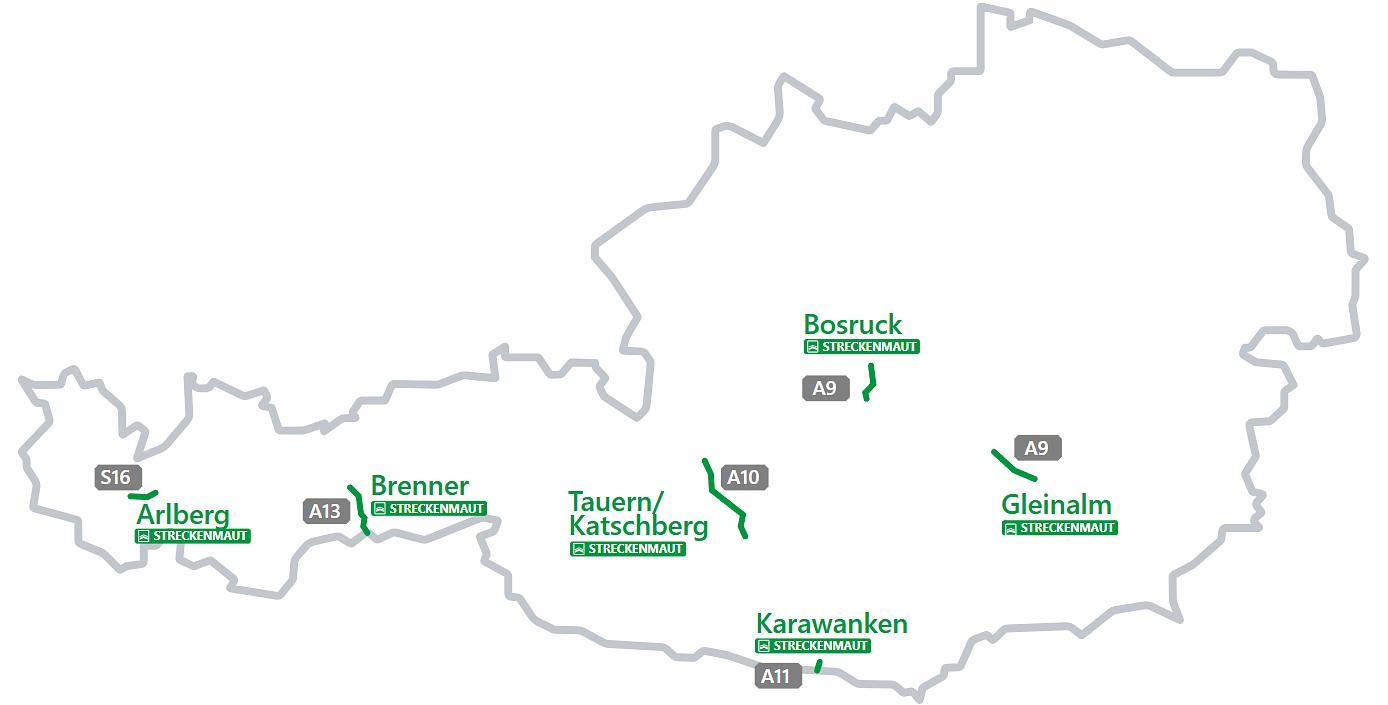
Austrian tunnels sit mainly in the central and western parts of the country. The map below shows the locations of the most important structures in the ASFINAG network.
Which are the most important tunnels in the Alps?
Below is a list of the longest structures in the Austrian motorway network:
| Tunnel | Road | Length | Location |
|---|---|---|---|
| Arlbergtunnel | S16 | approx. 14 km | St. Anton (Tyrol) – Langen (Vorarlberg) |
| Plabutschtunnel | A9 | approx. 10 km | Graz ring road (Styria) |
| Gleinalmtunnel | A9 | approx. 8.3 km | St. Michael – Übelbach (Styria) |
| Karawankentunnel | A11 | approx. 7.9 km | Rosenbach (AT) – Jesenice (SI) |
| Pfändertunnel | A14 | approx. 6.7 km | Bregenz (Vorarlberg) |
| Tauerntunnel | A10 | approx. 6.5 km | Flachau – Zederhaus (Salzburg) |
| Landecker Tunnel | A12 | approx. 7 km | Landeck (Tyrol) |
| Katschbergtunnel | A10 | approx. 5.9 km | St. Michael (Salzburg) – Rennweg (Carinthia) |
| Bosrucktunnel | A9 | approx. 5.5 km | Spital/Pyhrn (OÖ) – Ardning (Styria) |
| Felbertauerntunnel | B108 | approx. 5.3 km | Mittersill – Matrei (outside ASFINAG) |
| Roppener Tunnel | A12 | approx. 5.1 km | Ötztal – Imst (Tyrol) |
Good to know
Since 2004 ASFINAG has spent over €5 billion on modernising tunnels – second tubes, escape routes and firefighting systems. The trigger was the 1999 Tauern tunnel disaster: a collision set off a fire in which 12 people died.
Autopay x FLEX

Forget about buying a section toll ticket every time you drive through a tunnel in Austria. Discover FLEX, the system that settles your trips automatically without buying a ticket before each journey.
Discover FLEXWhich tunnels in Austria are tolled?
In Austria a separate toll applies on six sections of the ASFINAG network, regardless of whether you hold a valid vignette. The tolled sections are: the Arlberg tunnel (S16), the Bosruck + Gleinalm tunnels (A9), the Tauern + Katschberg tunnels (A10), the Karawanken tunnel (A11) and the Brenner motorway (A13).
Outside the ASFINAG network there is also the Felbertauern tunnel (5,304 m, road B108), run by an independent company. Neither the vignette nor the GO-Box applies here. You pay separately, directly at the entrance.
Good to know
The A13 Brenner is technically not a tunnel – it is a stretch of motorway crossing a pass at 1,374 m above sea level. It is, however, the most important Alpine crossing between Austria and Italy and one of the busiest transit routes in the whole of Europe.
Karawanken tunnel (A11) – €9
The Karawanken tunnel (7,864 m) links the Austrian A11 with the Slovenian A2 and is one of the main border crossings between the two countries. The tolled section runs between the St. Jakob im Rosental junction and the national border inside the tunnel.
A single trip costs €9.
It is charged separately on each side of the border: heading south you pay on the Austrian side (ASFINAG) and can buy the ticket online in advance; coming back north you pay at the Slovenian Hrušica toll point (operator DARS), on site only.
For frequent border crossers there is a monthly pass. It covers 14 trips within 30 calendar days from the date of issue. Unused trips expire after that period. The pass is tied to the registration number and costs €40.40. This is the only tolled ASFINAG section without an annual pass.
Buy your Karawanken tunnel ticket online – skip the queue at the barrier and drive through without stopping.
Buy a ticket – KarawankenArlberg tunnel (S16) – from €13
The Arlberg is the longest road tunnel in Austria (13,972 m) and the main link between Tyrol and Vorarlberg. The tolled section runs between the St. Anton am Arlberg and Langen am Arlberg junctions.
| Ticket type | Price |
|---|---|
| 1 trip | €13 |
| 2 trips | €26 |
| Annual pass | €78 |
Good to know
The Arlberg tunnel is one of the main routes to the Austrian ski resorts. In winter, heavy tourist traffic can make the queues at the barriers add a lot to your journey. It pays to buy the ticket online in advance.
Buy your Arlberg tunnel ticket online – in the green lane you only slow down to 15 km/h, the camera reads your plate and the barrier opens automatically.
Buy a ticket – ArlbergBosruck + Gleinalm tunnels (A9) – from €7
The A9 Pyhrn motorway runs through two separately tolled tunnels – Bosruck (5,509 m) and Gleinalm (8,320 m). Bosruck lies between the Spital/Pyhrn and Ardning junctions, Gleinalm between St. Michael and Übelbach. Both sit on the same route, but tens of kilometres apart, so the toll is charged at each one separately.
ASFINAG does offer a combined ticket, which is more convenient and slightly cheaper than two separate trips.
| Section | 1 trip | 2 trips |
|---|---|---|
| Bosruck | €7 | €14 |
| Gleinalm | €12 | €25 |
| Bosruck + Gleinalm together | €19 | €38 |
| Annual pass (both tunnels) | €80 | |
Good to know
If you drive the A9 both ways, the 2-trip ticket is worth it. One purchase then covers both tunnels in each direction.
Buy the combined Bosruck and Gleinalm ticket online – one purchase, both tunnels, both directions.
Buy a ticket – Bosruck + GleinalmTauern + Katschberg tunnels (A10) – from €15
The A10 is the main route through the central Alps, running from Salzburg towards Carinthia and Slovenia. Two separately tolled tunnels lie on this stretch – Tauern (6,546 m) and Katschberg (5,898 m). They are, however, charged under one combined toll. The tolled section runs between the Flachau and Rennweg junctions.
| Ticket type | Price |
|---|---|
| 1 trip (both tunnels) | €15 |
| 2 trips | €30 |
| Partial trip | €7.50 |
| Annual pass | €90 |
There is also a partial trip option for €7.50. It covers one of the shorter sections: St. Michael – Rennweg, St. Michael – Flachau or Zederhaus – Flachau. Useful if you leave the route before one of the tunnels.
Good to know
The A10 is one of the busiest routes in Austria, especially in the ski and summer seasons. At peak times the queues at the barriers can add tens of minutes to your journey. A ticket bought online lets you skip the congested lanes and drive through without stopping.
Buy your Tauern and Katschberg ticket online – one trip covers both tunnels and you skip the seasonal queues.
Buy a ticket – Tauern + KatschbergBrenner motorway (A13) – from €12.50
The A13 Brenner is a 35-kilometre stretch linking Innsbruck with the Italian border. The toll applies along the whole motorway, regardless of the vignette you hold.
| Ticket type | Price |
|---|---|
| 1 trip | €12.50 |
| 2 trips | €25 |
| Annual pass | €75 |
| Innsbruck – Patsch/Europabrücke | €3.50 |
| Exit to Stubaital | €4 |
| Matrei – Brenner | €6 |
| Resident pass (Wipptal/Stubaital municipalities) | €12.50 |
A night tariff applies on the A13. Between 22:00 and 5:00 the rates for vehicles over 3.5 tonnes are higher. For cars the price is the same at any hour.
Good to know
Residents of the Wipptal and Stubaital regions can apply for a special resident pass, valid for a year from the date of issue. You need the vehicle registration document and proof of residence. The pass cannot be bought online because the documents have to be verified. Eighteen municipalities qualify, among them Ellbögen, Gries am Brenner, Matrei am Brenner, Steinach am Brenner, Neustift im Stubaital and Fulpmes.
Buy your Brenner motorway ticket online – pay once and drive the full 35 km to Italy without stopping.
Buy a ticket – Brenner A13Which tunnels in Austria are free?
The vast majority of tunnels in the ASFINAG network are free. Out of 170 structures, a separate toll is charged on only six sections (A9, A10, A11, A13 and S16). You will pass all the rest under the standard vignette, with no extra charges.
The largest free tunnels include Plabutsch (9,919 m) on the Graz ring road, Pfänder (6,718 m) near Bregenz and Landeck (approx. 6,900 m) in Tyrol.
Drive through Austria without stopping at the barriers!
Buy a ticket for the tolled tunnels or a motorway vignette online. Pay securely – card, BLIK, instant transfer. The official PDF confirmation reaches your e-mail within minutes.
Buy Austrian vignettesHow do you pay for driving through Austrian tunnels?
At the barriers on the tolled sections you can pay in several ways: cash in euros, credit or debit card (VISA, Mastercard, Maestro, American Express), fuel card (DKV, Shell, OMV, UTA and others) and contactless phone (Apple Pay, Google Pay).
On the A9, A10 and A13 there are also dedicated orange lanes with machines. They take cards only, but they are much faster than a traditional barrier.
Single ticket
One trip in one direction, valid for a year from purchase. If you buy the ticket online, at the barrier you only slow down to 15 km/h in the green lane – the camera reads your plate and the barrier opens automatically.
Annual pass
Unlimited trips on the chosen section for a year. Cheaper per trip than a single ticket if you use the section regularly. Not available on the A11 Karawanken.
FLEX – automatic toll collection
FLEX is the ASFINAG system that lets you drive the tolled motorway sections in Austria without buying a ticket before each trip. A one-off registration of your registration number together with a payment card is enough – every trip is detected automatically by the cameras at the barriers and settled monthly, without stopping and without picking a ticket in advance.
How does registration work?
Registration happens online, on the ASFINAG website: you give your vehicle registration number and the details of the payment card to be charged.
From activation onwards you do not have to remember to buy tickets or log into any portal before setting off – just drive through the tolled section and the system recognises the vehicle by its plate.
You register the payment card once, and the toll is charged automatically after every trip through any tolled section. The cost will never exceed the price of the annual pass. It does not work on the A11 Karawanken only.
Which sections does FLEX cover?
| Section | Road | FLEX |
|---|---|---|
| Arlberg tunnel | S16 | Yes |
| Bosruck + Gleinalm tunnels | A9 | Yes |
| Tauern + Katschberg tunnels | A10 | Yes |
| Brenner motorway | A13 | Yes |
| Karawanken tunnel | A11 | No |
Good to know
The total charged under FLEX on a given section within a year will never exceed the price of the annual pass for that section. Once that limit is reached, further trips that year are free – the system works as an automatic cap, with no need to count your trips yourself.
Travel with Autopay – without limits!
Pick a ticket for a specific section or discover FLEX, the system that settles your trips automatically without buying a ticket before each journey.
Buy a section toll ticket Discover FLEXCommuter pass
Available only to people living and working in Austria. It covers unlimited trips for 365 days. Not available on the A11 Karawanken.
Holders of a free vignette (on the basis of a disabled parking badge under § 29b) receive an automatic free annual pass for all tolled ASFINAG sections, except the A11 Karawanken.
Good to know
Motorcyclists cannot use the digital lanes. The cameras cannot read multi-line plates, so you have to stop at the barrier. Driving without a valid ticket means a substitute charge: €200 for a car or €100 for a motorcycle. Refusing to pay on the spot means a fine of €300 to €3,000.
Are any tunnels in Austria closed?
Austrian tunnels are under regular modernisation and maintenance work. Some structures are temporarily closed or subject to traffic restrictions.
The biggest impact on traffic right now is the Karawanken tunnel. The new eastern tube officially opened on 18-03-2026 after seven and a half years of construction. The old western tube will stay closed until the summer of 2029, with traffic running both ways through the new tube.
Tunnels under repair in 2026
Structures currently under modernisation:
- Pfänder (A14) – night work Monday to Thursday, speed limit of 60 km/h, completion planned for October 2026.
- Roppener (A12) – work resumed from April to September 2026, modernisation of the northern tube.
- Brentenberg (A10) – partial night closures from April to June 2026 after a lorry fire in January 2026.
- Semmering tunnel chain (S6) – modernisation in stages until the end of 2029.
- Absberg and Laaerberg (S1, Vienna) – work until July 2026.
Good to know
Current closures and diversions are on the ASFINAG website – the information is updated continuously and it is worth checking the day before you set off.
Which tunnels are currently being built in Austria?
ASFINAG is running several large road projects that will affect driving through Austria in the coming years:
- Landeck tunnel (A12) – construction of a parallel escape tunnel, a full closure is planned from autumn 2026.
- Tauern and Katschberg tunnels (A10) – the largest tunnel renovation project in ASFINAG's history, planned for 2027–2033. During that time traffic will run in one tube only, with a speed limit of 60–80 km/h.
- Plabutsch – modernisation announced in the ASFINAG construction programme for 2026–2031.
- S10 – further extension to the Czech border at Wullowitz.
Before setting off it is worth checking the current state of the works on the ASFINAG website, especially if your route runs along the A10 or A12.
Which railway tunnels are there in Austria?
Austria is running one of the most ambitious railway programmes in Europe. Three projects form the so-called New Southern Line, meant to connect Vienna with Venice through the Alps:
- Koralmtunnel (33 km) – opened in December 2025, the sixth longest railway tunnel in the world. It cut the Graz–Klagenfurt journey from over 3 hours to about 45 minutes.
- Semmering Basistunnel (27.3 km) – under construction since 2012, opening planned for 2030. Once running it will cut the Vienna–Graz journey to about 1 hour 50 minutes.
- Brenner Basistunnel (55 km) – will link Innsbruck with Fortezza in Italy, opening planned for December 2032.
Once all three projects are finished, Austria will have the fastest railway link across the Alps.
Summary
In Austria you will pass most tunnels under the standard vignette, but six sections need a separate ticket. Before setting off, check whether your route runs along the A9, A10, A11, A13 or S16, and buy the ticket online. You will save time at the barriers and avoid unpleasant surprises.
If you are planning a trip through Austria in 2026, also check the current state of the works on the ASFINAG website – especially on the routes through the Karawanken tunnel, the A10 and the A12, where the largest modernisation works are under way.
Have a good trip!


